
When surgery is recommended, patients often hear terms like laparoscopic surgery and robotic surgery and wonder which is better. Both are forms of minimally invasive surgery and use small incisions instead of the larger incision required for traditional open surgery.
The important point is that robotic surgery is not automatically better than laparoscopic surgery. The right approach depends on the procedure, the patient’s condition and the surgeon’s expertise.
What Is Laparoscopic Surgery?
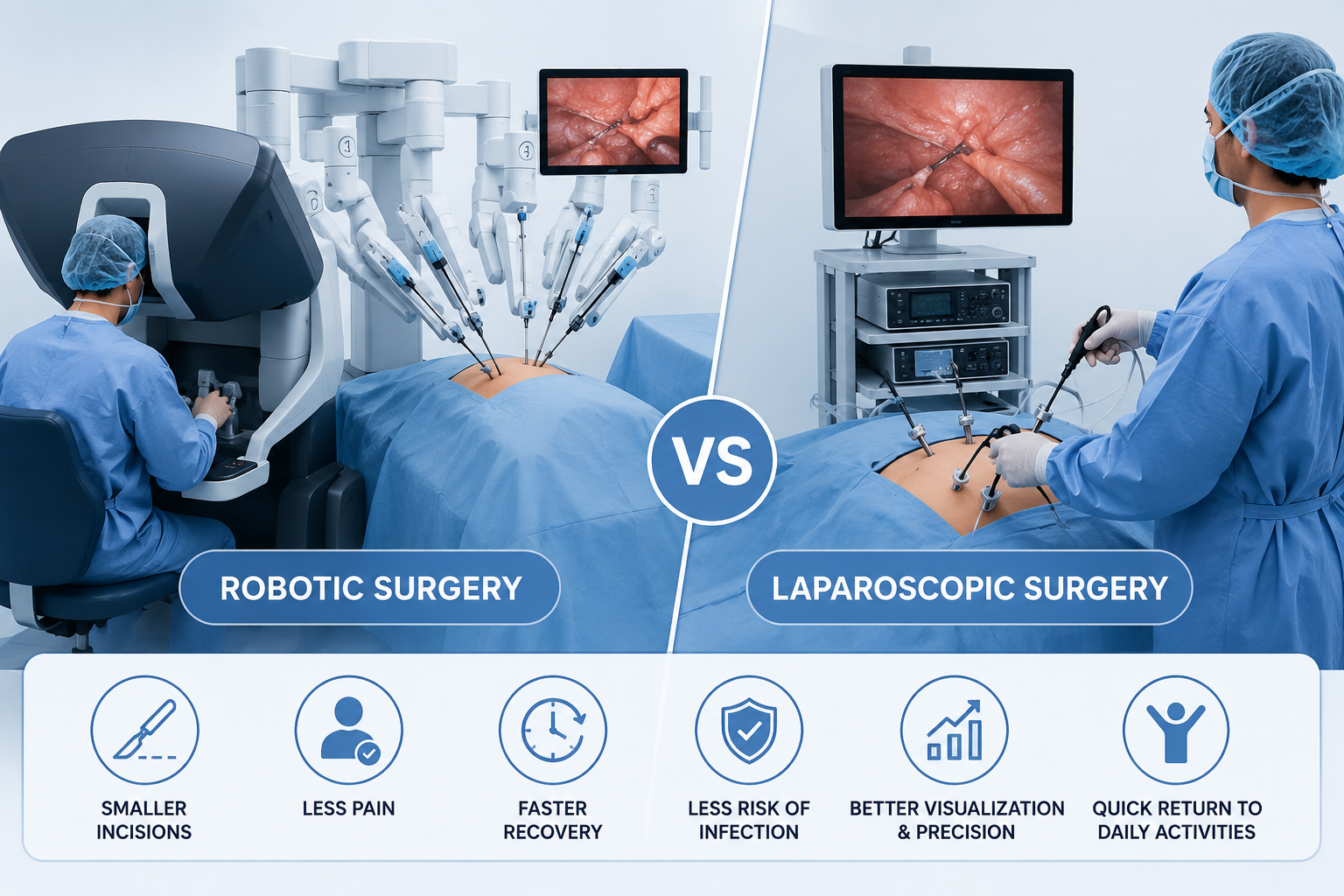
Laparoscopic surgery, often called keyhole surgery, is performed through small incisions using a thin camera called a laparoscope. The surgeon views the operating area on a monitor and controls specialised surgical instruments directly.
It is commonly used for procedures such as gallbladder removal, hernia repair, bariatric surgery, colorectal surgery and several other abdominal procedures.
What Is Robotic Surgery?
Robotic surgery is an advanced form of minimally invasive surgery. The surgeon controls specialised robotic instruments from a console while viewing the surgical field in high-definition, often 3D, vision.
Robotic systems provide features such as enhanced instrument movement, motion scaling and improved ergonomics, which can be particularly useful during technically complex procedures or when operating in confined spaces.
Robotic vs Laparoscopic Surgery: What’s the Difference?
| Feature | Laparoscopic Surgery | Robotic Surgery |
|---|---|---|
| Incisions | Small | Small |
| Surgeon control | Direct instrument control | Console-controlled instruments |
| Visualisation | High-definition camera | Enhanced, often 3D vision |
| Instrument movement | Limited wrist movement | Greater articulation |
| Surgeon ergonomics | More demanding | Generally more ergonomic |
| Cost | Usually lower | Usually higher |
Both approaches can offer the benefits of minimally invasive surgery, including smaller incisions and potentially less postoperative pain and faster recovery compared with open surgery.
Is Robotic Surgery Better Than Laparoscopic Surgery?
Not necessarily. For many procedures, clinical outcomes can be comparable between robotic and laparoscopic approaches. Robotic technology may offer advantages in selected complex operations, but these benefits do not automatically translate into better outcomes for every patient or procedure.
The surgeon’s experience, the complexity of the condition and the specific procedure often matter more than whether the operation is labelled “robotic” or “laparoscopic.”
Which Surgical Approach Is Right for You?
Your surgeon may consider:
- The type and complexity of surgery required
- Your anatomy and overall health
- Previous abdominal operations
- The surgeon’s experience with each technique
- Expected risks, recovery and cost
Frequently Asked Questions
Is robotic surgery safer than laparoscopic surgery?
Both can be safe and effective when performed by appropriately trained surgeons. Safety depends on the procedure, patient and surgical expertise.
Does robotic surgery mean the robot performs the operation?
No. The surgeon remains in control of the robotic system throughout the procedure.
Is robotic surgery more expensive?
It generally involves higher technology and operating costs than conventional laparoscopy.
Which is better for cancer surgery?
There is no single answer. The appropriate approach depends on the type and stage of cancer, the planned operation and the surgeon’s expertise.
The Bottom Line
Robotic surgery and laparoscopic surgery are both valuable minimally invasive techniques. Rather than choosing a technology first, patients should choose the approach that is most appropriate for their specific condition and procedure.
The experienced minimally invasive surgeon’s at CUSP can explain the available options, including their benefits, limitations, risks and expected recovery, and help determine the most suitable approach.