
Finding a pancreatic cyst on an ultrasound, CT scan, or MRI can be alarming for many patients. The immediate concern is often cancer. However, it is important to understand that not all pancreatic cysts are dangerous or cancerous. In fact, a large number of them are benign and may never cause any health problems throughout a person’s life.
Some cysts only require periodic monitoring, while others may need closer evaluation or treatment depending on their characteristics. The decision is based on several factors, including the cyst’s type, size, growth pattern, location, and associated symptoms.
What Is a Pancreatic Cyst?
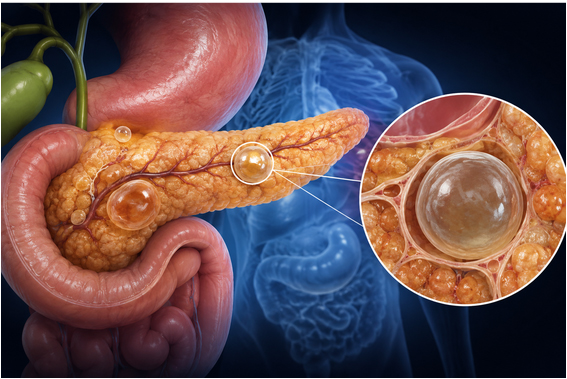
A pancreatic cyst is a fluid-filled sac that forms within or around the pancreas. These cysts can develop for different reasons. Some appear after an episode of pancreatitis (inflammation of the pancreas), while others are true cystic tumors that arise from pancreatic tissue.
These are broadly classified into several types:
- Pancreatic pseudocysts – These are the most common and usually occur after pancreatitis. They are generally non-cancerous.
- Serous cystic neoplasms (SCNs) – Typically benign and slow-growing, with very low malignant potential.
- Mucinous cystic neoplasms (MCNs) – These have a higher risk of becoming cancerous over time and often require closer evaluation.
- Intraductal papillary mucinous neoplasms (IPMNs) – These arise from the pancreatic ducts and can range from low-risk to high-risk lesions depending on their features.
Correctly identifying the type of pancreatic cystic lesion is essential because it directly influences management decisions and follow-up plans.
When Can a Pancreatic Cyst Be Concerning?
While many pancreatic cysts are harmless, certain features may raise concern and require further investigation. Doctors usually look for “high-risk” or “worrisome” signs on imaging and clinical evaluation
A pancreatic cyst may be more concerning if it:
- Increases in size over time
- Develops solid components, nodules, or thickened walls
- Causes symptoms such as abdominal pain, jaundice, or unexplained weight loss
- Leads to recurrent episodes of pancreatitis
- Is associated with dilation of the pancreatic duct
- Shows suspicious features on CT, MRI, or endoscopic ultrasound
The risk level is not determined by size alone. Even small cysts can sometimes have concerning features, while larger cysts may still be benign. This is why detailed imaging and specialist evaluation are important.
Does Every Pancreatic Cyst Need Surgery?
The simple answer is no. In fact, most pancreatic cysts do not require immediate surgery. Many can be safely managed with active surveillance, which involves regular imaging tests to monitor for changes.
Common diagnostic tools include:
- MRI scans, which provide detailed soft tissue imaging
- CT scans, useful for structural assessment
- Endoscopic ultrasound (EUS), which allows close evaluation and sometimes fluid sampling
The frequency of follow-up depends on the cyst type and its risk profile. Some cysts may be checked every 6–12 months, while others may require less frequent monitoring.
When is Pancreatic Cyst Surgery Considered?
Pancreatic cyst surgery is usually recommended only when the benefits outweigh the risks. Pancreatic surgery is a major procedure, so doctors aim to avoid unnecessary operations whenever possible. The goal is to remove only those cysts that pose a real threat to health.
Surgery may be considered if the cyst:
- Has high-risk features suggesting possible malignancy
- Continues to grow over time
- Causes significant or persistent symptoms
- Is confirmed or strongly suspected to be pre-cancerous or cancerous
When Should You See a Specialist?
You should consult a specialist if a pancreatic cyst is newly diagnosed, shows concerning features, grows over time, causes symptoms, or if you are unsure whether monitoring or treatment is appropriate. Prompt evaluation is especially important if you develop jaundice, persistent abdominal pain, unexplained weight loss, or recurrent pancreatitis.
A multidisciplinary team may include:
- HPB (hepatopancreatobiliary) surgeons
- Gastroenterologists
- Radiologists
For complex cysts or cases in which surgery may be necessary, consulting CUSP Surgeons, a group of specialists experienced in complex pancreatic and upper gastrointestinal procedures, can be valuable. They can review the imaging, assess the need for surgery, explain the risks and benefits, and recommend the most appropriate treatment approach. Their expertise is particularly helpful because pancreatic surgery can be technically demanding.
The team will evaluate imaging findings, clinical history, and risk factors to decide whether monitoring, further testing, or pancreatic cyst removal is best. If surgery is needed, specialists can also determine whether a minimally invasive laparoscopic or robotic approach is suitable.
The Bottom Line
A pancreatic cyst is not automatically dangerous. Many are benign and can be safely observed over time. The key is accurate diagnosis and regular follow-up when needed. With proper evaluation, doctors can determine whether a cyst requires simple monitoring, further testing, or surgical removal. Early specialist consultation ensures the safest and most appropriate treatment plan for each individual patient.